This Is Chuck Schumer’s Flimsy Excuse for Supporting Data Center Bill
The people voted against data centers all around the country in the midterms. Our representatives responded by shoving Trump’s data center bill down our throats. Chuck Schumer is helping.


Senate Minority Leader Chuck Schumer (D-NY) has framed his support for a data center bill as acknowledging the “affordability” crisis, but in reality the bill will do little to help in the long run and might even increase costs for consumers in the short run.
The Daily is people-first journalism from the Heartland. Please support our work by becoming a subscriber.
Schumer was one of 14 Democrats who voted Wednesday to advance the “Bipartisan American Affordability and Jobs Act” (BAAJA). It cleared a procedural vote 65-31.
Critics and analysts have already pointed out that while BAAJA is allegedly designed to lower energy costs, certain provisions and market dynamics could still raise consumer bills or deliver only limited savings.
Sen. Shelley Moore Capito (R-WV) is the lead sponsor of this bill, with Senators Sheldon Whitehouse (D-RI), Mike Lee (R-UT), and Martin Heinrich (D-NM) sponsoring.
It has support from the Trump White House.
Senators John Thune, Eric Schmitt, Josh Hawley, and Jerry Moran have also been involved in shaping amendments to it. Yes, that Josh Hawley.

There he is, fleeing from another disaster he encouraged by raising his fist toward the January 6th insurrectionists in solidarity, riling them up and agitating them even more.
This time, Hawley voted no on the bill, although earlier he supported it. Much like his support for insurrection, apparently, it depends.
The bill is also supported by Americans for Free Markets.
None of this is encouraging.
Earth Justice argues that BAAJA does not function as a true affordability measure, but rather primarily speeds up permits for fossil fuel projects and data centers while offering consumers at most modest savings.
They are not alone in seeing this bill this way.
Any affordability gains from new generation and transmission lines could take years to materialize, whereas regulators can allow utilities to recover financing costs during construction—meaning customers may pay for infrastructure before it is finished or lowers bills, an analysis by the Center on Global Energy Policy at Columbia University determined.
Pay attention to this:
“Affordability gains from increased generation and transmission supply are plausible but conditional, and could take years to materialize—well after the costs are incurred. Greater supply, transmission, and use of existing grid capacity can reduce congestion and connect consumers to cheaper generation. However, because regulators can allow utilities to recover financing costs during construction, customers may begin paying for infrastructure before it is completed or its benefits are realized. The net effect will therefore depend on what gets built and, perhaps more importantly, who pays for upgrades.”
I’m living in a data center construction area, and our rates have skyrocketed. We were given the runaround about why, so don’t expect there to be ready answers to these questions. When experts raise concerns, they don’t always have the data yet to formulate the exact question. But that alone should be enough reason not to push forward legislation like this.
The rate increases are difficult to manage, especially as they come with skyrocketing gas, grocery and healthcare bills. This is not something most American families can easily absorb right now, and the long term “savings” possibility does not justify the short term harm.
They note that the purpose of this bill is actually to speed up how energy infrastructure gets built, “it seeks to change how quickly energy infrastructure is approved and built, rather than determine what gets built.”
It shifts the leverage from reviewing parties to the applicants, in other words, it makes it easier for Amazon and Meta and the rest of the greedy earth destroyers who refuse to give back even while they use the infrastructure we all pay for.
It will shove federal approvals through and they will be difficult to reverse. “Federal approvals would become faster to obtain and harder to reverse. BAAJA narrows environmental review, tightens deadlines, limits who can sue and when, removes the ability of courts to halt projects based on deficient reviews alone, and bars most interference with fully permitted projects.”
Gosh, that seems like something that would be helpful for Chuck Schumer’s daughter, Jessica Schumer. Jessica joined OpenAI in late 2026 as the company's “head of policy and partnerships” across the Northeast U.S.
The data center provisions look dubious at best:
“The data center provisions offer mixed protection for existing customers and could push some load off the grid. Large computational loads would pay the incremental costs of serving them, but these protections would not reach higher wholesale capacity and energy prices, a principal way data centers raise household bills in restructured markets such as PJM. ”
None of this looks intended to help the American people. It reads like the tech version of the trickle down promise. That has not worked out, and this won’t work out for the people either.
Earth Justice pointed out that Ezra Klein has been pushing Democrats to support this. I’m not sure exactly how long Ezra Klein has been absolutely wrong about what the Democratic Party should do, but it’s been a while.
“Ezra Klein is urging Congress to roll the dice on the Bipartisan American Affordability and Jobs Act (BAAJA) even though he admits in his latest column that he is “unnerved” by the differing impacts of this bill reported by Hill staffers and conscious that “legislation at this scale rarely plays out exactly as its architects expect.” As he recognizes, much of the 400+ page bill is “dedicated to technical changes to other laws,” Earth Justice wrote.
“Nevertheless, he remains sure that the bill will engender better politics and a nation that can deliver all the goods we need.”
It’s giving ivory tower, whereas I am covering this a few miles from the construction of an a massive hyperscale data center project in Homer City, Pennsylvania, where a 4.4-gigawatt, gas-fired power plant is being built to fuel a massive AI data center campus. It’s roughly 5 square miles big.
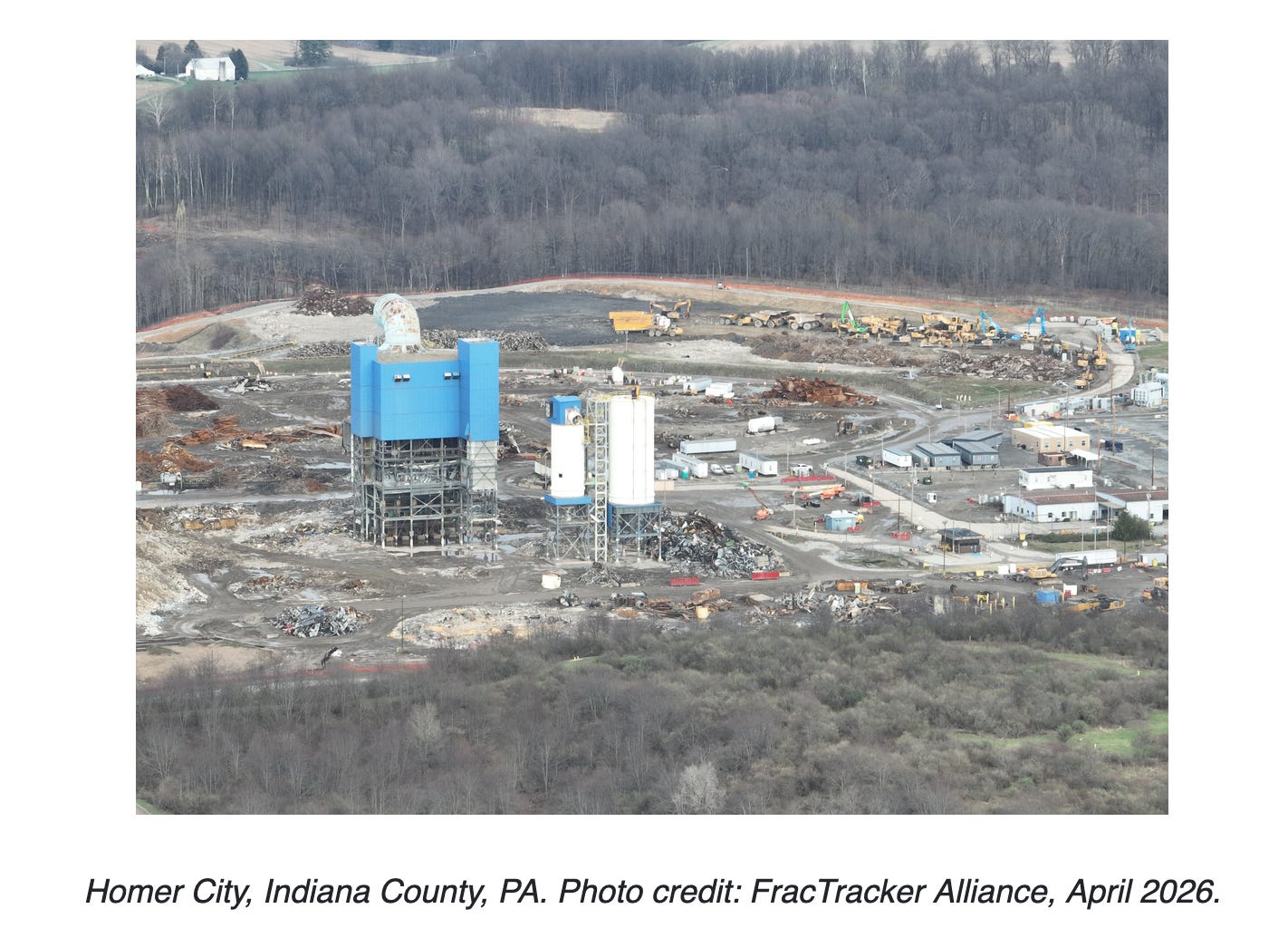
Welcome, respiratory illnesses and lung cancer, thanks for dying for Big Tech’s pocketbook.